Summary
UGVs are reshaping how dismounted units operate by reducing physical load, extending reconnaissance, and improving survivability. This blog examines their battlefield roles, lessons from Russia-Ukraine war, the shift toward a tiered unmanned ecosystem, and the challenges limiting wider adoption.
The Problem UGVs Were Built to Solve
Dismounted infantry have always faced the same basic constraint: a soldier can only carry so much more weight before mobility, endurance, and reaction time start to suffer. At the same time, the ‘last tactical mile’, i.e., the final stretch between support units and the front line, is consistently described as the most dangerous and logistically complex part of the battlefield, where equipment, ammunition, and casualties all have to move under direct enemy observation and fire. Unamanned ground vehicles exist to take weight, risk, and routine tasks off the soldier’s shoulders without pulling a human away from the fight to do it.
Core Roles UGVs Fill for Dismounted Units
Carrying the load: The most immediate and widely adopted role is simply hauling gear. A UGV can carry batteries, water, ammunition, and heavy weapons systems that would otherwise exhaust a squad, letting soldiers move faster and arrive at the objective less fatigued. Unmanned ground platforms can reduce the physical burden on soldiers while extending the operational reach and mobility of dismounted units.
Casualty evacuation: Getting a wounded soldier out of a contested area is one of the highest-risk tasks in ground combat, and it’s increasingly being handed to robots.The Army’s pursuit of a ‘last tactical mile’ UGV centres on two primary functions: transporting cargo forward, and evacuating at least two casualties from the point of injury without worsening their condition. It is a capability designed explicitly to keep more humans out of the most exposed terrain on the battlefield.
Reconnaissance and surveillance: UGVs are increasingly scouting ahead of dismounted formulations, extending a unit's situational awareness before soldiers physically enter a space. Quadrupedal unmanned platforms can support dismounted troops by scouting hazardous areas ahead of the unit, providing early situational awareness while reducing direct exposure to risk.
Combat support and direct engagement: Some UGVs go beyond logistics and scouting int armed roles such as mounting remote weapon stations, suppressing enemy fire, or acting as a mobile shield in urban combat.
Engineering and obstacle-clearing: UGVs are also used for breaching and sapper-type work, such as clearing obstacles, detecting and disposing of IEDs, and handling tasks that are both labour intensive and disproportionately dangerous for a human to perform manually.
Security and perimeter protection: Beyond maneuver support, armed UGVs are being used to patrol logistics routes and protect high-value assets like air defence systems, artillery radars, and command posts, freeing soldiers from static guard duties so they can be used elsewhere.
Russia Ukraine War: The Proving Ground
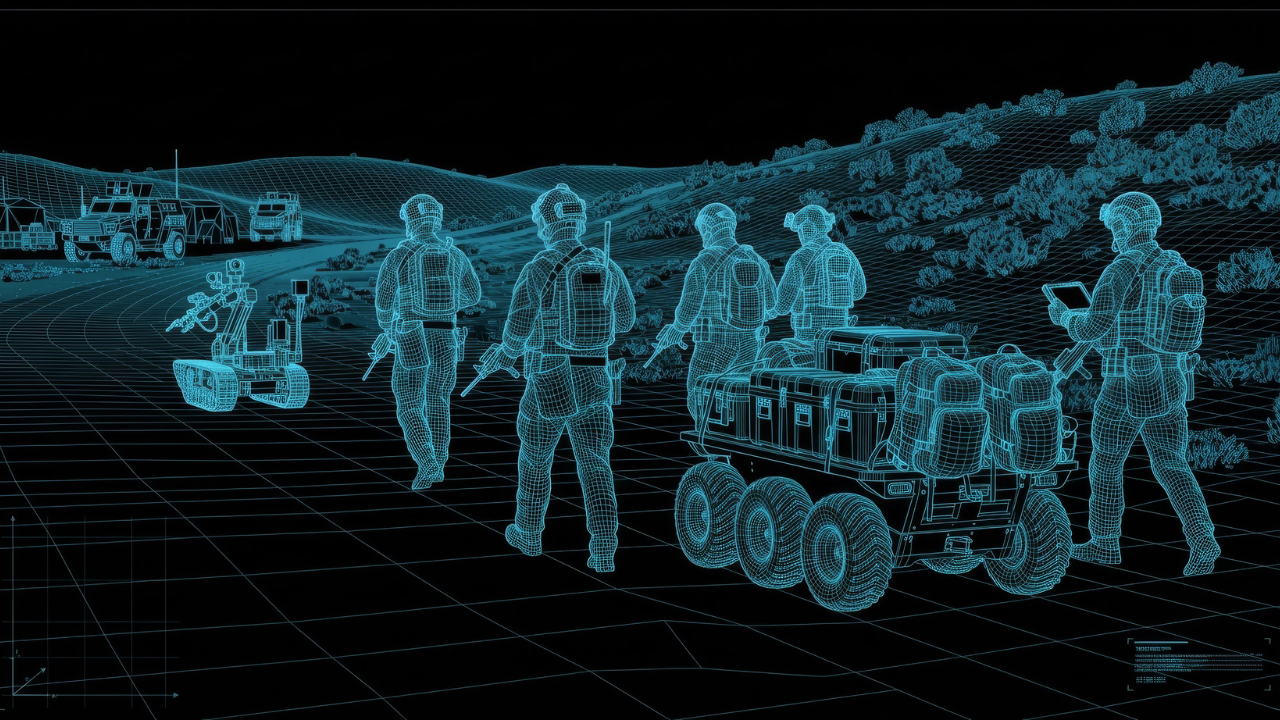
No conflict has shaped UGV doctrine faster than the war in Ukraine. Both sides have invested heavily in ground robot technology, and by early 2026, that investment had produced a sharp increase in deployed systems and a rapid expansion of the roles those systems fill. Real combat employment, apart from lab testing, has directly driven innovation in both tactics and technology, pushing UGV roles to evolve faster than peacetime procurement cycles typically allow.One trend emerging from that experience is the idea of an unmanned ‘umbrella’ of support accompanying infantry, such as ground-based electronic-warfare carriers, perimeter security platforms, and logistics-route patrols all operating alongside dismounted troops rather than replacing them.
The Doctrinal Shift: A Tiered Ecosystem, Not One Robot
Rather than converging on a single do-everything platform, the emerging doctrine favors a tiered ecosystem: small, expendable, human-supervised systems handling lower-level tactical tasks, complemented by larger, more protected platforms for higher-end roles as the technology and trust in both mature. This mirrors how human formations are more organized, with different systems scaled to different levels of risk and responsibility rather than expecting one robot to be a scout, a pack mule, and a weapons platform all at once.
What Still Limits UGV Adoption
Despite rapid progress, UGVs face real operating constraints. Many current systems still depend heavily on remote operators or line-of-sight control, and contested electromagnetic environments can disrupt the communications links that UGVs rely on for navigation and command. Newer platforms are being built to operate in GPS-denied conditions, and maintain reliable communications across supported units even across difficult terrain. It is a sign that resilience against jamming and signal denial, not just mobility and payload capacity, is now treated as a core design strength rather than an afterthought.
The Bottom Line
UGVs aren’t being fielded to replace dismounted infantry, but rather to make them more sustainable in a fight. Every pound a robot carries is a pound that a soldier doesn’t have to, every casualty evacuated by a machine is a rescue that doesn’t require a second person to risk exposure, and every obstacle cleared or every route scouted by an unmanned system is one less first look a human has to take. As the technology matures and formations like the Army’s robotics-equipped Multipurpose Companies become more common, the dismounted squad of the near future looks less like a group of soldiers and more like a small, networked team of humans and machines sharing the risk of a flight.
Disclaimer: This post is intended for general informational purposes and draws on publicly available military and defense industry reporting.